Drive Cleaner & Duplicate Finder for Google Drive
Duplicate files and storage clutter are hard to find manually in Google Drive. Here's how Drive cleaner tools work, what they scan, and when they're worth using.
Overdrive Team//7 min read

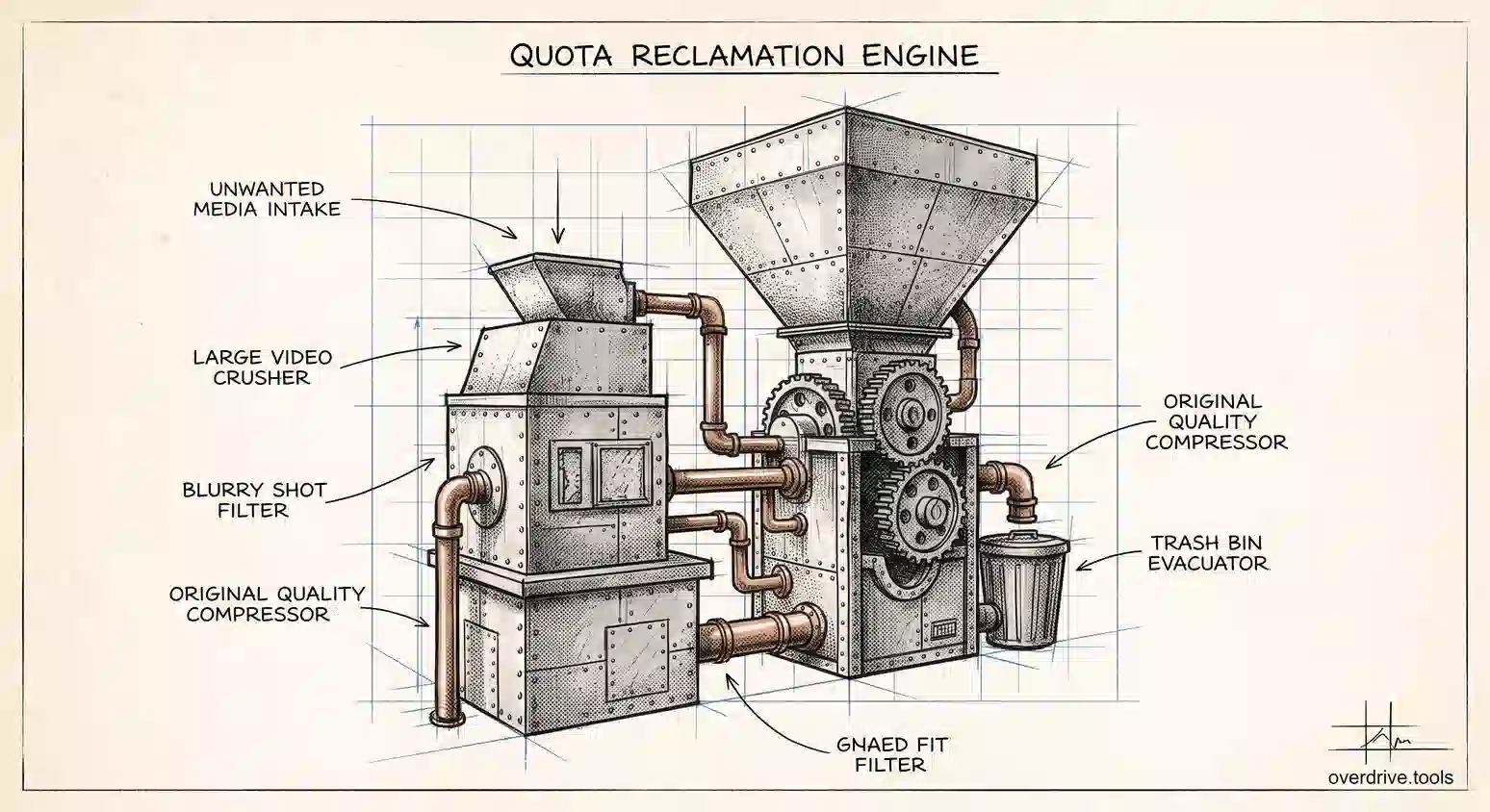
Google Drive makes it easy to create files and nearly impossible to manage the aftermath. Documents get duplicated across folders. Old project archives pile up. Empty folders accumulate after reorganizations. Untitled files appear from quick-open sessions that were never finished. None of this shows up as a problem in Drive's interface — until you hit the storage limit and have no idea why.
Drive cleaner and duplicate finder tools exist to solve this specific problem: surfacing what's cluttering your Drive so you can remove it efficiently, without opening and reviewing files one by one.
Why Manual Cleanup Doesn't Scale
For a Drive with a few hundred files, manual cleanup is manageable. You can scroll through your storage view, look for large files, and spot obvious duplicates. It takes time, but it's doable.
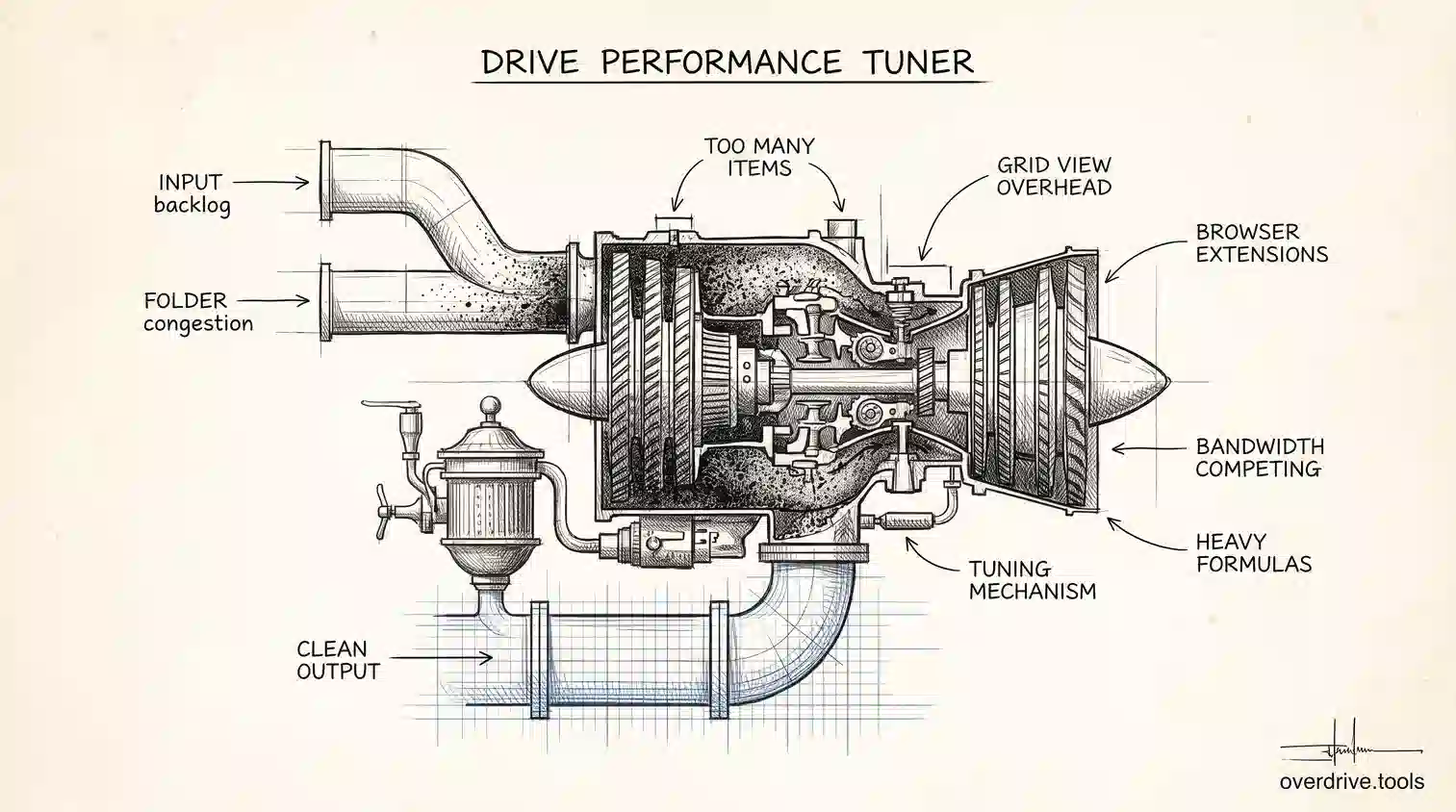
For Drives with thousands of files — which is common for anyone who's been using Drive for several years, moved through multiple jobs, or collaborated on many shared projects — manual cleanup breaks down quickly. Duplicates rarely have identical names. A file called "Q4 Budget" and "Q4 Budget copy" in different folders are clearly duplicates. But "Q4 Budget Final," "Q4 Budget REVISED," and "Q4 Budget v3" across three different folders require opening each to compare — and that's just one file pattern out of potentially hundreds.
Finding empty folders manually means clicking through every folder in your Drive hierarchy to check whether it has contents. Finding all large files requires going to the storage page and manually sorting. Finding everything shared with a specific person requires running multiple searches. None of these tasks is impossible, but together they take hours in a large Drive.
What a Drive Cleaner App Actually Does
Drive cleaner tools work by scanning your Drive's file metadata — the information Google maintains about every file, including its name, size, type, creation date, modification date, parent folder, and sharing settings — and then analyzing patterns in that data.
Critically, they don't read the content of your files. A duplicate finder identifies files with the same name, size, type, and creation date without opening the files themselves. A storage analyzer looks at file sizes and types without reading what's inside. A permissions auditor reads sharing settings without accessing document content.
This metadata-only approach is what makes these tools fast (metadata queries are much faster than content reads) and privacy-respecting (your documents stay private). A well-built Drive cleaner tells you about your Drive's structure, not its contents.
The output is typically a dashboard that surfaces: duplicate file groups you can review and remove, large files sorted by size, empty folders you can delete, files that haven't been touched in years, and sharing anomalies like files still accessible to people who've left your organization.
Finding Duplicates: How It Works
Duplicate detection in a Drive context works by comparing file fingerprints — combinations of attributes that together identify whether two files are the same. At minimum, this includes file size and name. More sophisticated detection also compares modification dates, file type, and in some cases content hashes (a short numerical representation derived from file contents, without reading the contents directly).
When the tool groups potential duplicates, it presents them for you to review rather than auto-deleting anything. This is important because not all "duplicates" should be deleted. A file with the same name in two different folders might be an intentional copy kept for separate contexts. A "Budget Final" and "Budget Final v2" might have meaningful differences in a few cells despite looking similar.
Good duplicate detection shows you the groups and lets you decide which version to keep, rather than making that decision automatically. The value is in surfacing the candidates quickly — the decision about which to keep is still yours.
Storage Visualization: Seeing Your Drive Differently
One of the more useful features in Drive cleaner tools is storage visualization — showing how your storage is distributed in ways that Google's native interface doesn't.
Google Drive's storage page (drive.google.com/drive/quota) shows a flat list of files sorted by size. It doesn't show you that one folder is responsible for 40% of your storage, or that video files are taking up three times as much space as everything else combined. Visualization tools provide a map of your Drive that makes the big consumers immediately obvious.
Seeing this breakdown changes how you approach cleanup. Instead of searching for what to delete, you can go directly to the folders and file types that matter most.
Permissions Auditing Alongside Storage
Storage and permissions are related problems. A Drive that's been used for years has usually accumulated both storage clutter and permission clutter — files shared with people who've left, old "anyone with the link" shares from documents sent to clients years ago, and permissions granted for short-term collaborations that were never revoked.
The best Drive management tools handle both problems in one place. Rather than cleaning up your storage today and remembering to do a permission audit separately next month, you can address both in one session. Finding that an old shared folder is responsible for both excess storage and excess access — and being able to clean both at once — is more efficient than treating them as separate tasks.
Overdrive covers both storage and permissions in a single scan: it surfaces duplicate files, large files, empty folders, and untitled clutter on the storage side, while also showing active sharing permissions, external shares, and files still accessible to former collaborators on the security side.
How Drive Health Scores Work
Some Drive management tools offer a "Drive Health Score" — a single number that summarizes the state of your Drive across multiple dimensions. The score typically reflects a combination of: what percentage of your storage is duplicates or clutter, how many files have open or risky sharing settings, how many empty folders exist, and how much of your storage quota is currently used.
A health score is useful because it gives you a benchmark. Rather than trying to hold all of these dimensions in your head separately, a score tells you at a glance whether your Drive is in good shape or needs attention. Improving the score becomes a concrete goal, and checking it periodically gives you an early signal before problems compound.
What Happens After You Install a Drive Cleaner
After installing a Drive cleaner from the Google Workspace Marketplace and connecting it to your account, the first thing it typically does is scan your Drive — this can take anywhere from a few seconds to several minutes depending on how many files you have.
The scan is read-only. Nothing is changed or deleted during the initial scan. What you get is a report: here are your duplicates, here are your large files, here's who has access to what. From there, you review the findings and decide what to remove or adjust.
When you do choose to delete files or change permissions, the tool makes those changes via Google's API on your behalf — exactly as if you had made the changes in Drive directly. You can watch the deletions happen and stop the process if anything looks wrong.
After the initial cleanup, most people check in periodically — monthly or quarterly — to catch new clutter before it accumulates. The first cleanup session is the most intensive; subsequent sessions are usually much faster because there's less to review.
When a Cleaner Tool Is and Isn't Worth Using
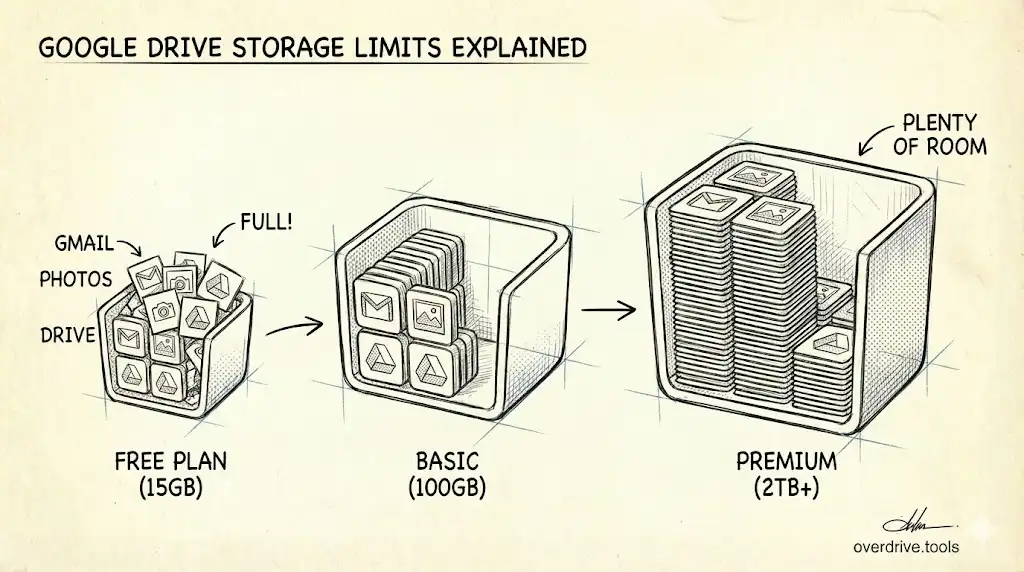
A Drive cleaner tool is worth it when your Drive has grown large enough that manual management isn't practical. The threshold varies by person, but a Drive with more than a few thousand files, or one that's more than 50% full without a clear reason why, is a good candidate.
It's less necessary if you actively maintain your Drive — regularly deleting files after projects end, never duplicating files across folders, and keeping a simple structure. Some people's drives stay naturally organized; others accumulate clutter regardless of intentions.
It's also less useful if your storage problem is primarily in Gmail or Google Photos rather than Drive itself. Check one.google.com/storage to see the breakdown before spending time on a Drive cleanup that won't move the needle.
Frequently Asked Questions
Does a Drive cleaner read my file contents? A well-built tool does not. Duplicate detection, storage analysis, and permission auditing all work on file metadata — names, sizes, types, dates, sharing settings — not on what's inside your files. Check the app's privacy policy to confirm this, and review the permissions it requests during OAuth setup.
What if I accidentally delete a file using a cleaner tool? Files deleted through a Drive management tool go to your Google Drive Trash, not permanently deleted immediately. You have 30 days to restore from Trash before permanent deletion. This is the same behavior as deleting files directly in Drive.
Can a Drive cleaner tool access Shared Drives? It depends on the tool and the permissions granted during setup. Some tools only work on your personal My Drive; others can also access Shared Drives if you grant that permission. Check the app's documentation for what's covered.
How long does the initial Drive scan take? For a Drive with a few thousand files, typically under a minute. For very large Drives — tens of thousands of files — it can take several minutes. The scan runs in the background and doesn't require you to stay on the page.
Is it safe to let a third-party app access my Google Drive? Apps listed in the Google Workspace Marketplace have been reviewed by Google and use the standard OAuth authorization system. That said, you should still read the privacy policy, review the permissions requested, and check that the developer has a legitimate web presence and support channel. Revoking access is straightforward at any time through myaccount.google.com/permissions.
Do I need to install anything on my computer? For web-based Drive cleaner tools, no — they run in your browser. You connect them to your Google account via OAuth and access them through a URL. No desktop installation required.
Related Articles
- How to Clean Up Google Drive
- Google Workspace Marketplace: Drive Apps Explained
- Why Is My Google Drive Full? (And How to Fix It)